
Most neighborhood events don’t fail because people don’t care. They fail because planning happens in the wrong places.
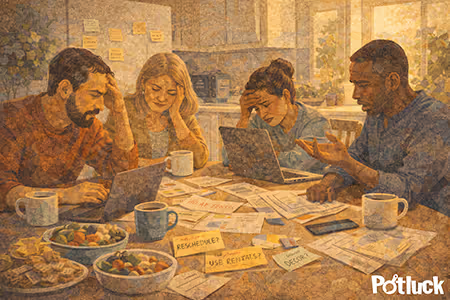
Group emails. Endless text threads. Facebook groups that mix announcements with noise. Spreadsheets that only one person understands.
None of these were designed to support real-world gatherings — especially recurring ones.
Neighborhood events need a different kind of space.
Planning Is Not the Same as Broadcasting
Many tools treat planning like communication. Share the details. Send reminders. Post updates.
But neighborhood events aren’t announcements. They’re shared responsibilities.
Planning needs to answer practical questions: Who’s coming? - Who’s bringing what? - What still needs to be done? - What worked last time?
Broadcast tools aren’t built for that.
Why Public Platforms Create Friction
Public or semi-public platforms optimize for reach and engagement.
Neighborhood events need: Clarity over visibility - Participation over reaction - Continuity over novelty.
When planning lives in public spaces:
- Important details get buried
- Participation feels optional
- Organizers end up chasing people
The tool shapes the behavior. And the wrong tool makes good intentions harder to act on.
Private Spaces Encourage Participation
In a private planning space, neighbors can:
- See the full plan at a glance
- Understand what’s needed
- Step into a role without awkward back-and-forth
Privacy removes performance. People don’t feel watched. They feel invited.
That shift alone increases follow-through.
Neighborhood Events Need Memory
One of the biggest challenges for HOAs and neighborhood groups is continuity. Board members rotate. Volunteers change.
But events should get easier — not harder — over time.
That only happens when planning tools retain: Guest lists - Event structures - Past decisions.
Without memory, every event resets. With memory, neighborhoods build momentum.
Why We Built Potluck for Neighborhoods
Potluck was built as a private social platform for organizing real-life gatherings.
Not a feed. Not a forum. A planning space.
For neighborhood events, Potluck provides:
- One dedicated event page that keeps everything in one place
- An interactive sign-up sheet that makes responsibility visible and shared
- An event chat focused on coordination, not noise
- Automatic retention of attendees as Connections, so guest lists grow over time
- Full event history, making it easy to duplicate and repeat successful gatherings
The more events you host, the easier planning becomes. That’s not accidental. It’s the point.
Why This Matters for HOAs and Neighborhood Leaders
Neighborhood leaders aren’t just planning events. They’re protecting community energy.
When planning lives in a private, purpose-built space: Fewer details fall through the cracks - Responsibility spreads naturally - Volunteers burn out less often - Events become repeatable instead of fragile.
Good systems protect relationships.
Paid Events Are Infrastructure, Not an Upsell
For neighborhoods hosting recurring events, reliability matters.
A paid event on Potluck unlocks: Sign-ups, event chat, and Moments - Retained Connections - Reusable event history.
This isn’t about premium features. It’s about using infrastructure that supports real community.
A paid event starts at $9.
Choose Tools That Match Your Goals
If your goal is stronger neighborhood connection, your planning tools should reflect that.
Choose a space designed for: Real people - Shared responsibility - Repeated gatherings
Because when planning feels lighter, people show up. And when people show up, community follows.
Start organizing your next neighborhood event with Potluck
This post is part of Potluck’s ongoing series on how neighborhoods become communities.